Optical Investing, Round Two: Which Names to Watch Now

Earlier this year, the theme that led the market’s big rally was without question the optical sector. Almost every optical stock set new all time highs, from at least 100% to several hundred percent, and every investor was looking at optics.
But was it that they had run up too far?
From June on, the entire market including semiconductors and memory began to correct, AI skepticism started to surface, and the optical sector too had to watch its share prices fall by more than half from the highs.
Some investors caught in the drawdown left the game altogether, saying the optical sector was finished.
And now in August, share prices look to be riding an upward trend again on the back of earnings from several optical companies.
Is this really the time to come back to optical investing?
Or is it only a temporary bounce, with a sharp rise like the one earlier this year unlikely for a while?
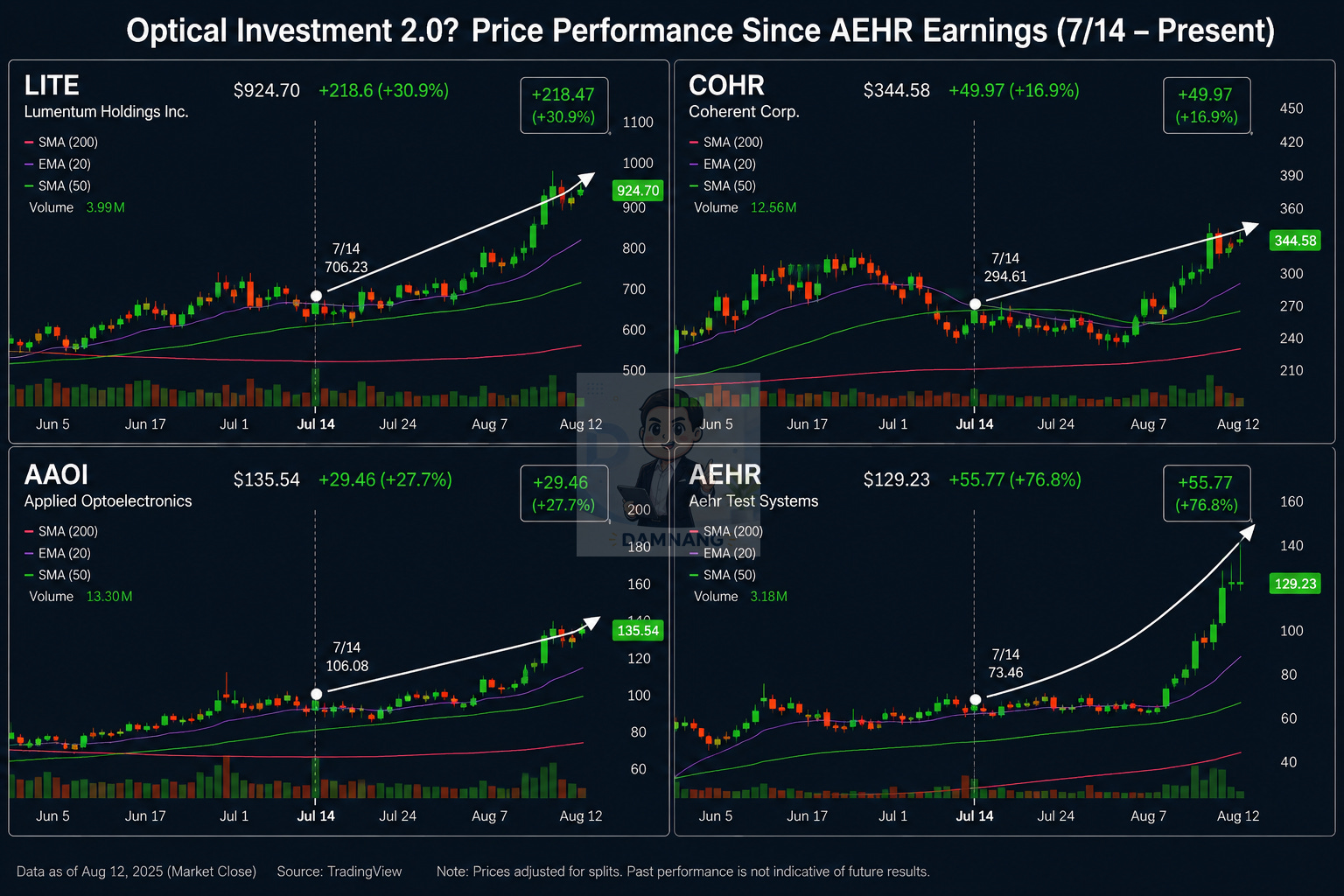
Those who have followed me on X and Substack will know that I have been arguing, ever since AEHR’s earnings came out, that round two of optical investing had started.


In fact, there was a slight correction after AEHR’s earnings release, but up to now optical stocks have been in an uptrend.
In this article, I want to lay out, in detail, the round two optical investing strategy that follows my earlier optical investment map.
Why this correction happened, where optics stands now and what points to look at closely, and if you were to start investing in the optical sector fresh at this point, which layer and which names in this complex optical ecosystem you should look at first.
If you are an investor who is going to take another serious look at the optical sector, I hope you read this article through.
Disclaimer
This article is personal analysis and is not investment advice. All investing should be done based on your own research. The author may hold positions in some of the names discussed and may change those positions without prior notice.
Why the June and July Correction Happened
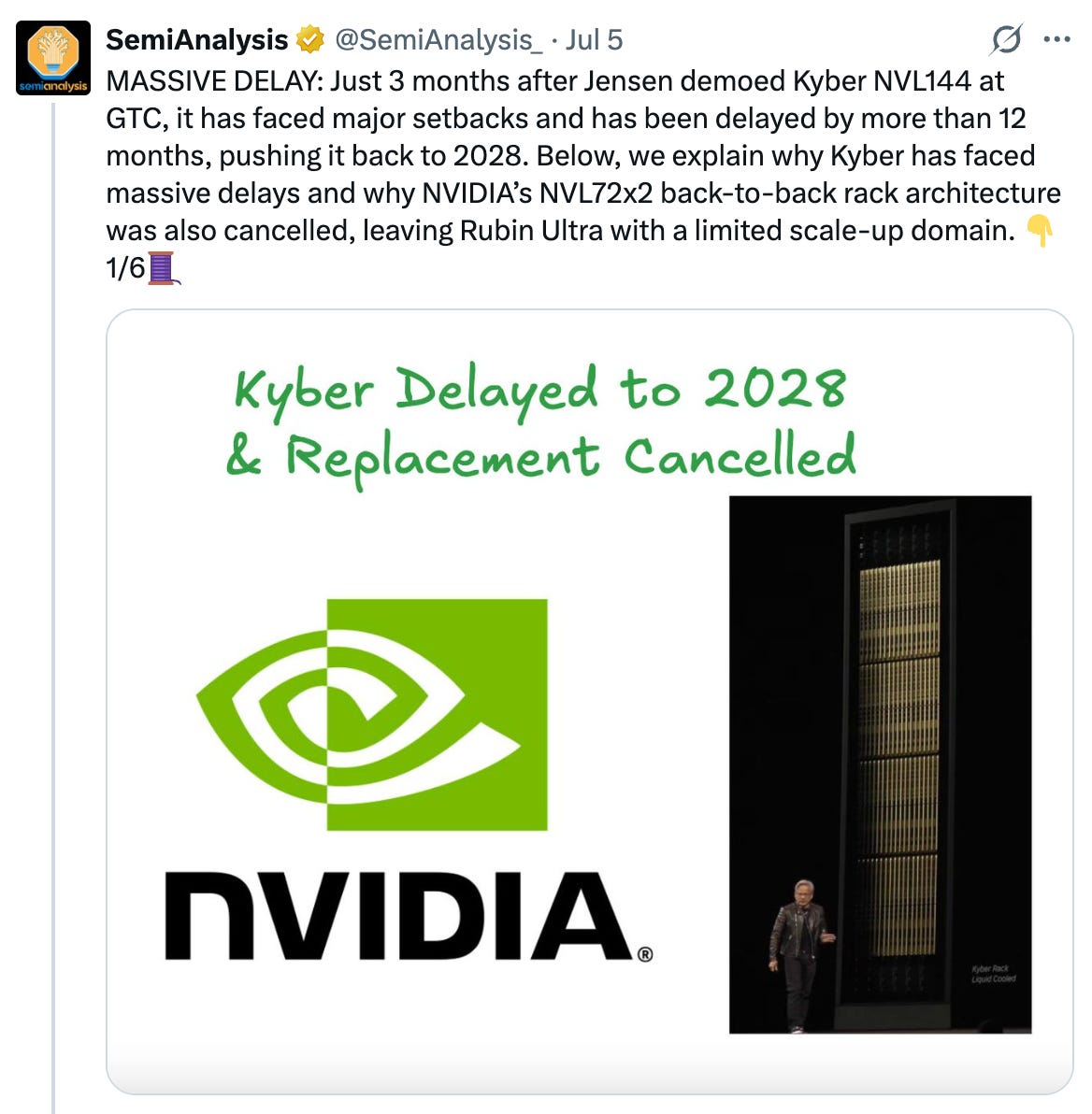
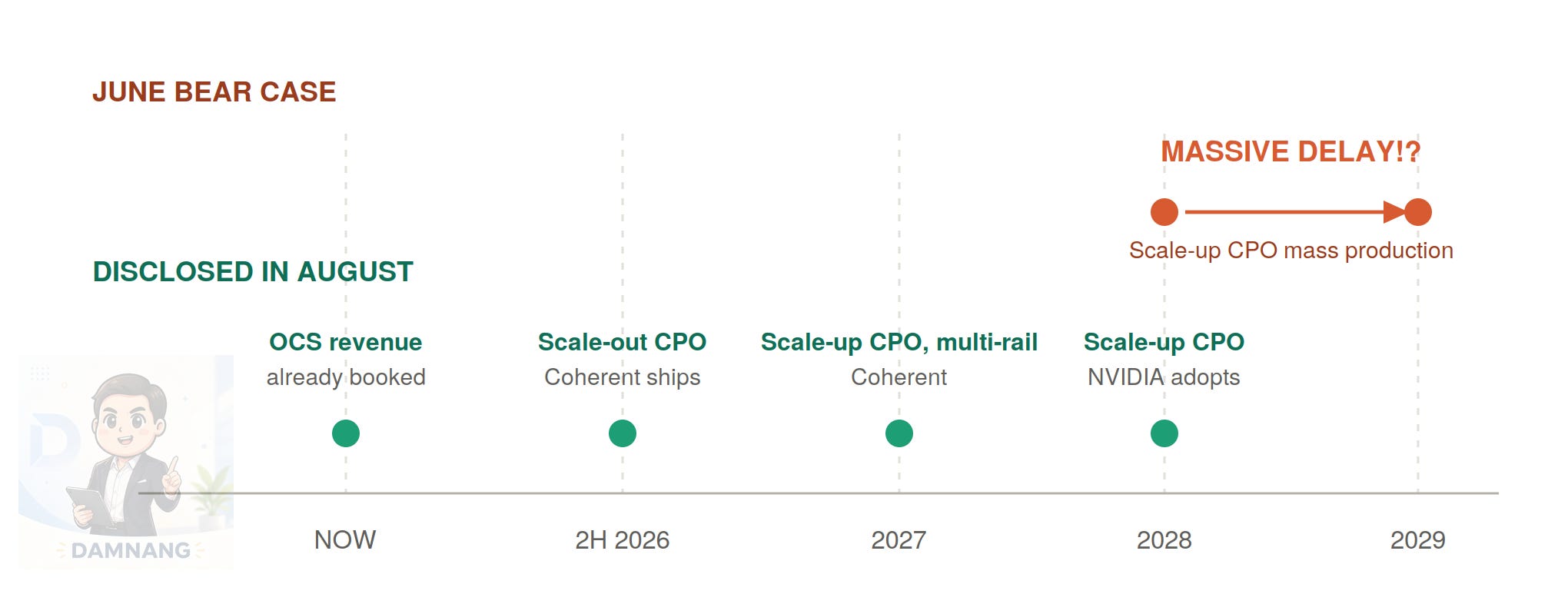
The starting point of the optical correction was SemiAnalysis’s CPO analysis. Along with the provocative phrase Massive Delay, it argued on the basis of low yields and cost burden that CPO mass production in the scale up segment would be pushed out from late 2028 to beyond 2029, and that until then copper and pluggable modules would keep the upper hand. After that publication, valuation adjustment appeared across the optical communications value chain.

On top of this, as AEC (Active Electrical Cable, a copper cable with a signal restoration chip built in) shipments grew quickly, a market consensus formed that in rack connectivity would be handled by copper for the time being, and the Optical I/O argument, that the transceiver module market shrinks once the electrical to optical conversion moves inside the GPU package, came back into focus as well.
Beyond that, optical stocks were already at three digit price to earnings ratios, so profit taking and index rebalancing compounded and the drawdown widened.
August, What Changed
On August 11, Lumentum said demand for ultra high power CPO lasers is increasing, that it had received an initial order for ELS modules, and that several NPO engagements are underway.
For its lead CPO customer, it said high volume shipments for scale up begin in the second half of 2027 with customer deployment in 2028.
The next day Coherent said there had been no case at all of CPO demand being pushed out and that customer interest had in fact increased.
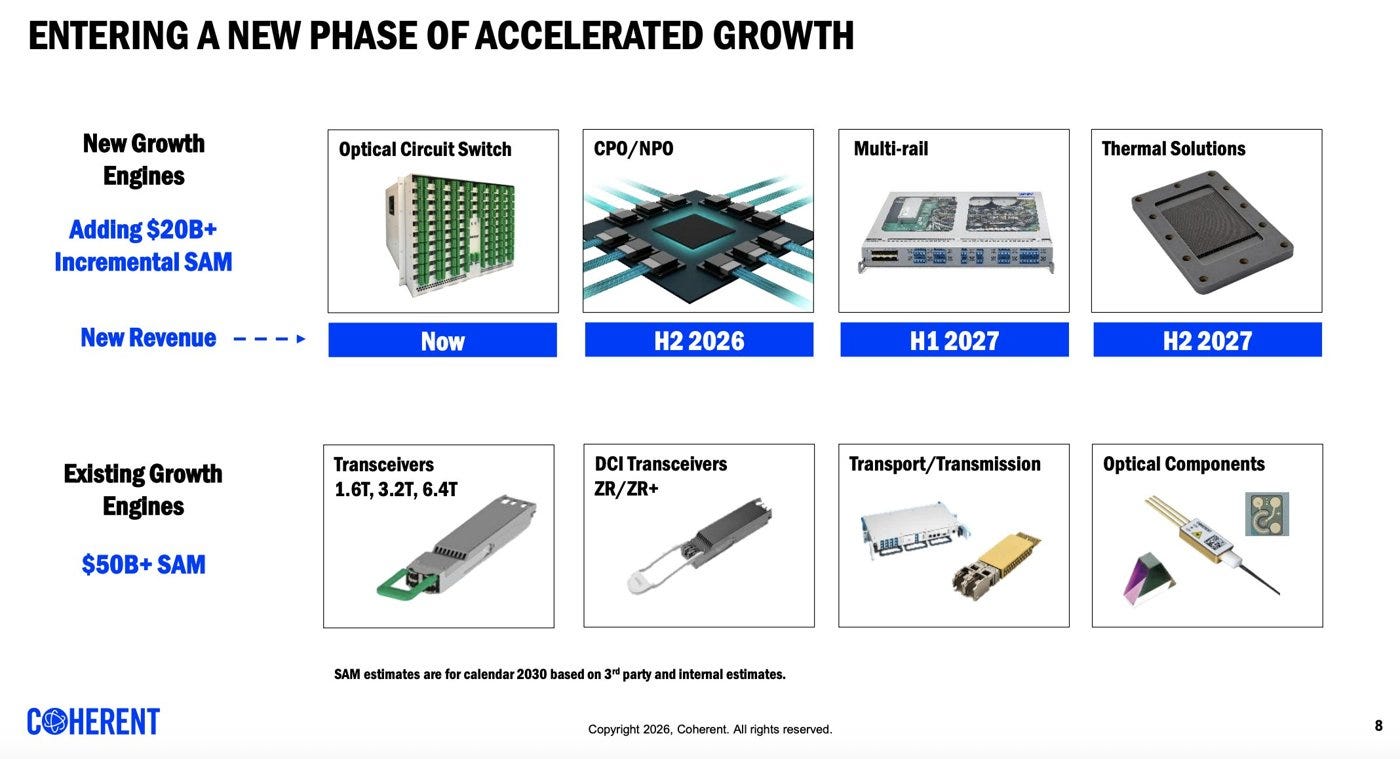
It added that scale out CPO revenue, connecting rack to rack, begins in the second half of 2026, that scale up, which ties multiple compute racks together within a cluster, follows in 2027, and that it is engaged with multiple customers on both CPO and NPO.
SemiAnalysis’s claim that NVIDIA’s scale up CPO mass production could be delayed beyond 2029 was confirmed to be untrue through the earnings calls of these two companies.
On top of this came OCS (Optical Circuit Switch) results.
OCS is equipment that switches the optical path directly instead of using an electrical switch, reducing the number of electrical switching hops. As Google shifted from what it had developed in house to external sourcing, Lumentum announced it had secured a backlog of more than $400 million from three new customers and will ship roughly $400 million in the second half of 2026. Coherent has already announced initial revenue, and on August 12 raised the size of this market to more than $4 billion.
Another of the most important items was Aehr’s earnings.
Test equipment orders are normally a leading indicator that runs several quarters to more than a year ahead of a customer’s production ramp, and Aehr guided FY2027 revenue to $130 million to $150 million, 2.6x to 3x the prior year, of which $100.6 million was announced as effective backlog already received. Its lead silicon photonics customer is already running an unmanned automated line, a follow on production order came in early August, and a new customer has already placed an order for four systems within a few months of first contact and taken delivery, so the order data showed that optical production ahead is going to grow much larger.
Why Optics, Why Now, Again
As we saw above, the fundamentals of optics have not changed. If anything, guidance has moved higher through this August earnings round. Coherent’s FY2027 first quarter guidance has a low end above the quarter just reported and gross margin is heading up as well. What fell in June and July was not earnings but the valuation multiple.
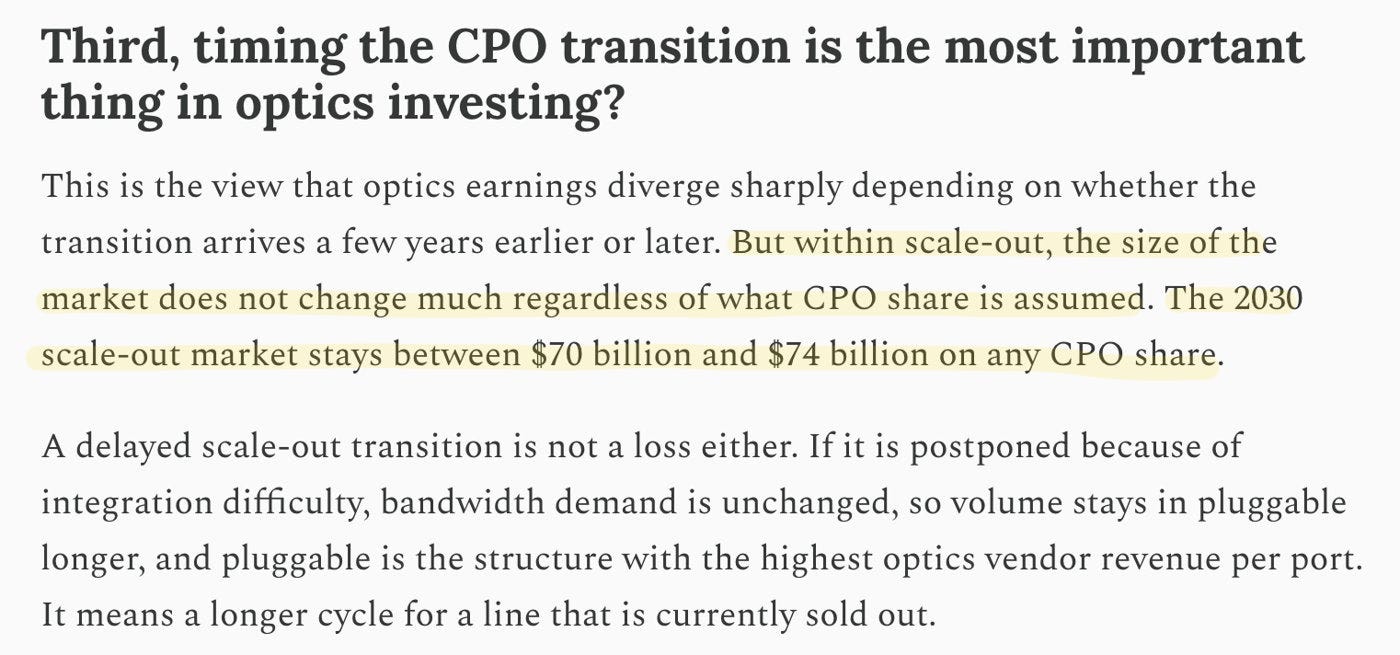
That optical connectivity grows as AI data centers get bigger is something no investor with conviction in this sector disagrees with. The problem was the market’s misunderstanding that this optical demand was tied to a single CPO timeline. Exactly as I emphasized in my earlier scale up CPO article, Coherent in this earnings round also reconfirmed that the content opportunity it captures is similar whether things go the CPO way or the NPO way.

Supply is still a bottleneck as well.
InP (Indium Phosphide, the compound substrate that laser chips are made on) wafer capacity is expected to grow by 20 to 30 times through 2029, and until then it looks unlikely to keep up with demand. Lumentum’s revenue and operating margin rising together in the quarter just reported is read as a positive signal that this supply bottleneck is currently converting into profitability.


More important is that optical investors’ sentiment is coming back. On August 4 there was a report that the FCC is preparing a draft rule restricting imports of new Chinese optical transceivers, and after that report the share prices of several optical stocks rose sharply.
Whether this regulation actually gets finalized remains to be seen, but it was good signal news in the sense that investors were reminded once again of how geopolitically important the optical theme is in its connection to AI. In addition, LYTE, the ETF that holds only the optical value chain, traded $72 million on its first day of listing on August 6. That is a bullish factor for optical investing and at the same time a crowding signal.

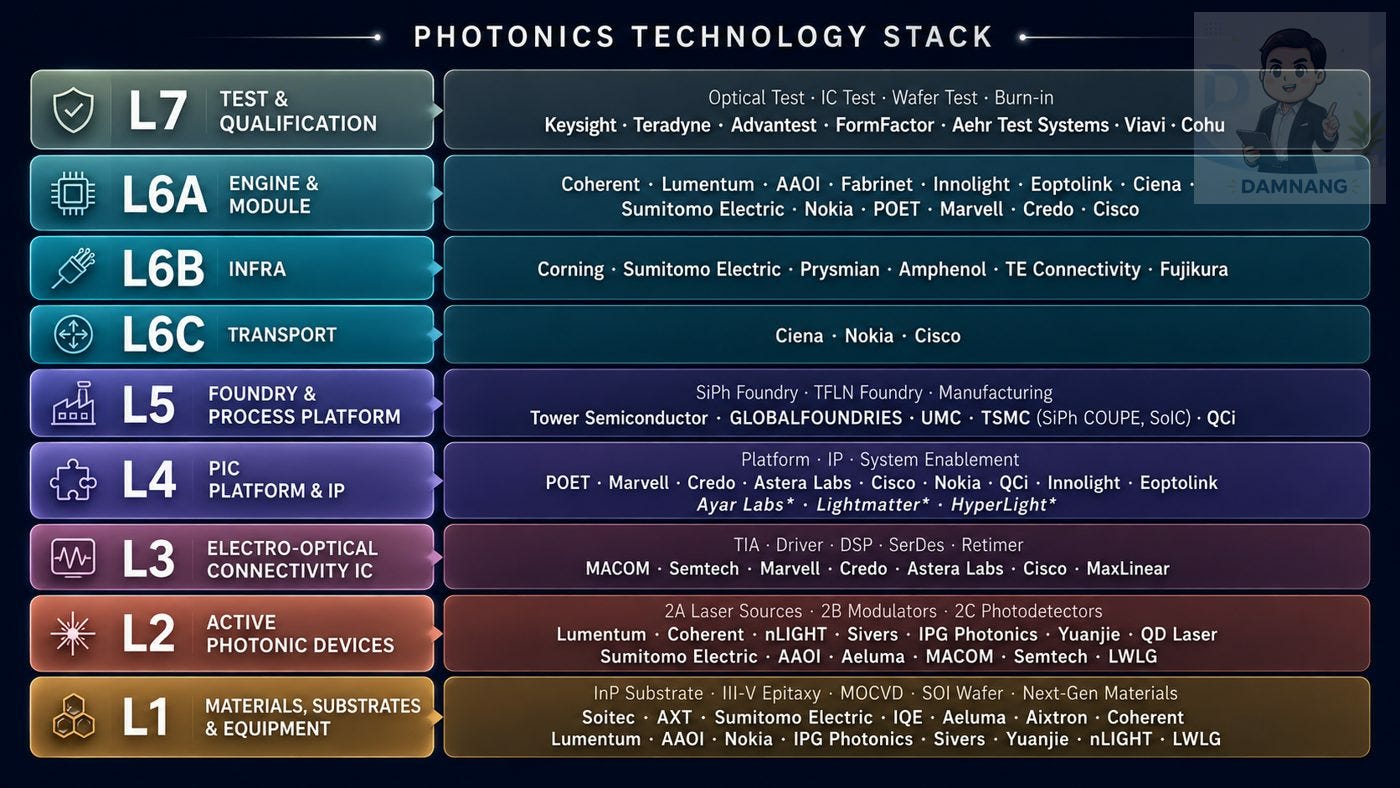
Still, what makes optical investing hard is that the optical ecosystem itself is so complex, and that each of these factors does not apply to every layer at the same time. To resolve this complexity, back in April I wrote an optical investment map. In this article I intend to use the layer map from that map again for analysis.
Unlike last time’s broad overview, in this article I plan to approach it from a perspective that is more useful to investors. In the end what investors are most curious about is, if I had to start optical investing now, again, which layer and which names among this many layers and names I should look at first, and how to think about investment strategy.
In the rest of this article I want to analyze this investment perspective in detail, together with the current state of optical technology development analyzed above.

If You Were Starting Optical Investing Now
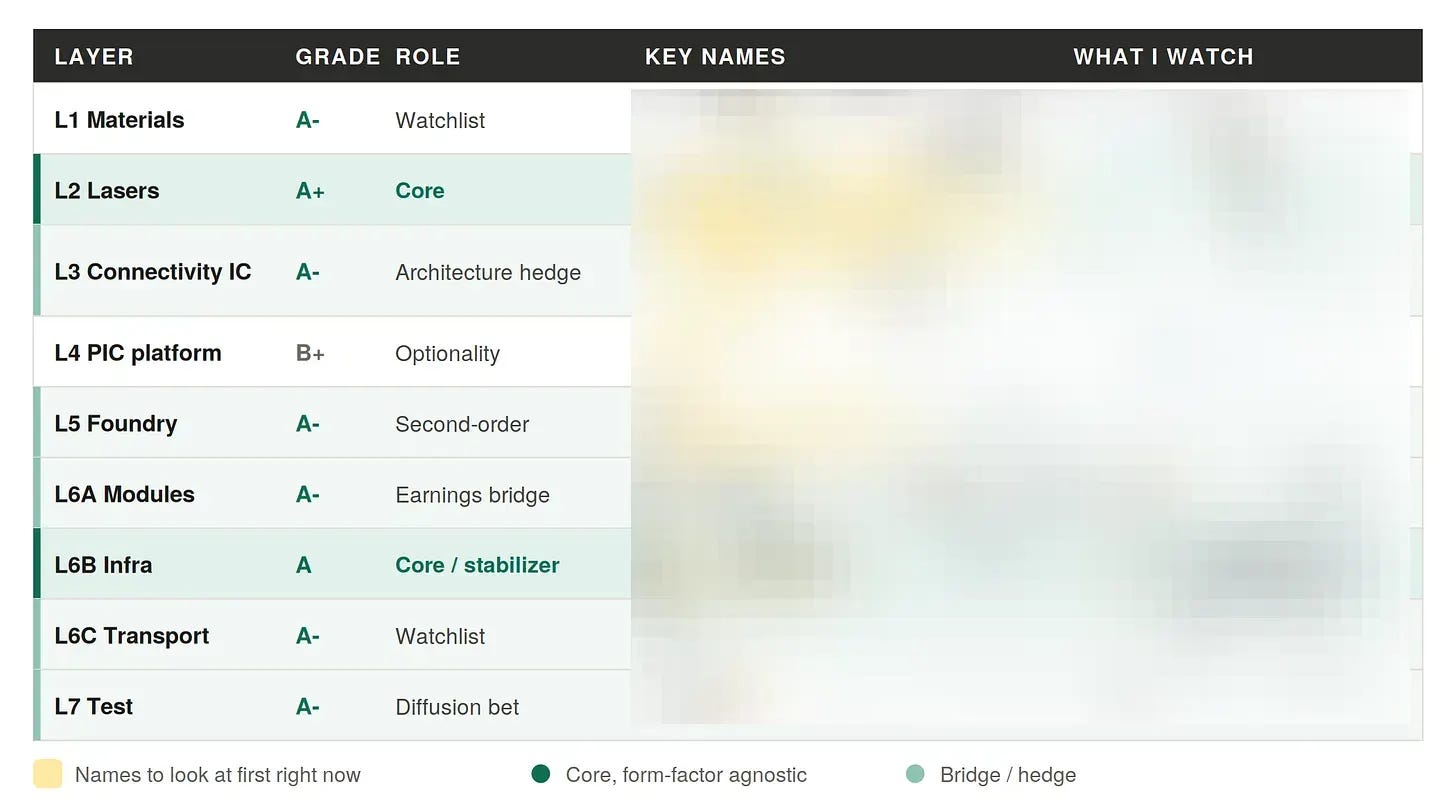
A note on reading the table
The names highlighted in yellow are ones the author has classified as priority watch candidates according to his own criteria, based on results disclosed to date and the outlook ahead. Whether a name is highlighted is not a recommendation to buy or sell, and a name that is not highlighted does not mean it is unsuitable for investment. The selection criteria and judgments are entirely the author’s own, and investment decisions should be made through your own research.