


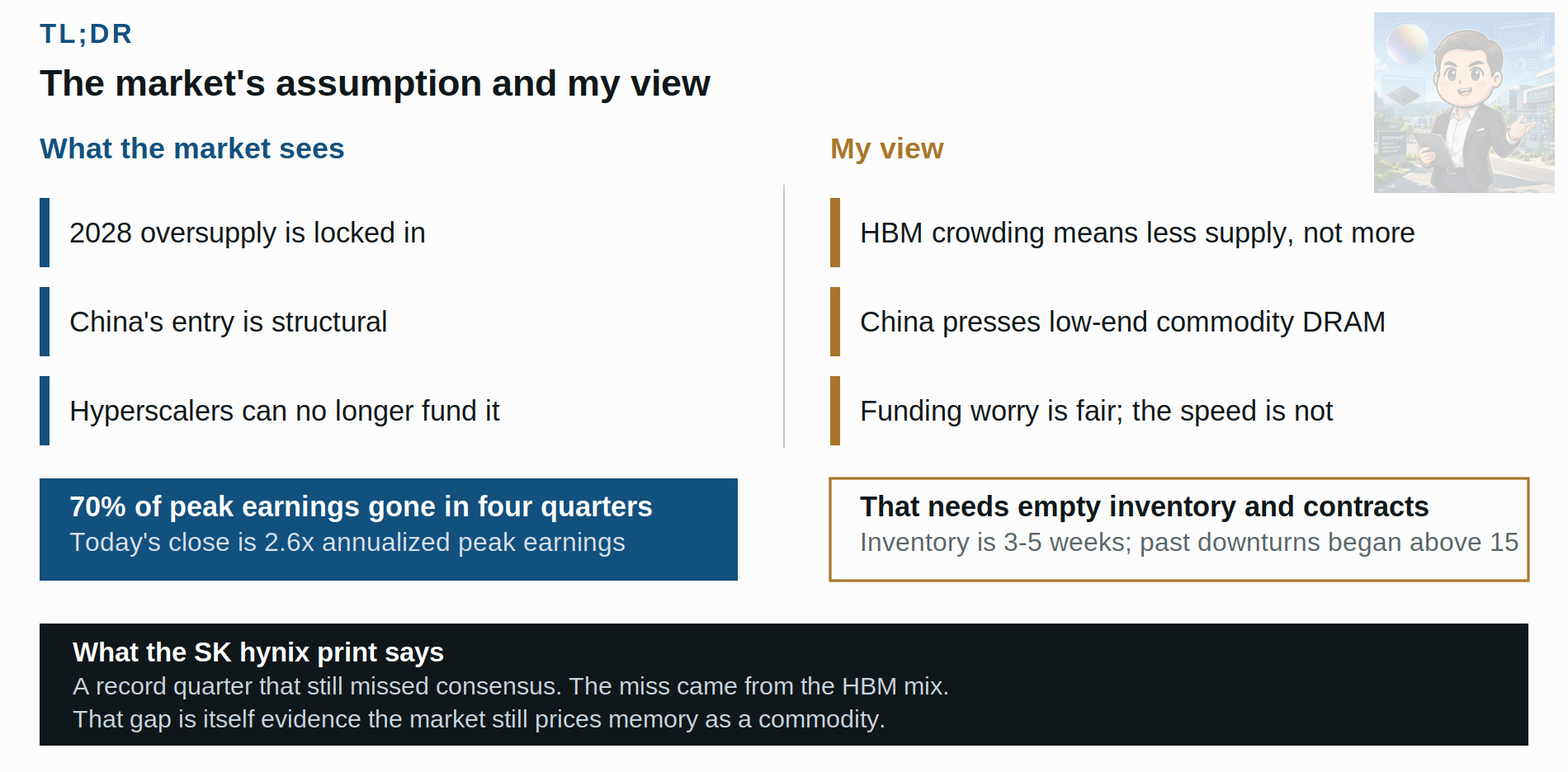
Many investors are worried that the sharp rally in semiconductor stocks that began last year may now be coming to an end, marking the start of a broader downturn.
Personally, I think the market's biggest concern right now is AI capex, and memory semiconductors may be one of the main reasons behind that concern.
Is this level of concern actually warranted?
Can the SK hynix results released on July 29 put it to rest?
This piece examines what the worry assumes and whether those assumptions hold.
Disclaimer
This article is for information only and is not a recommendation to buy or sell any security. Forecasts and judgments are the author’s own, and investment decisions remain the reader’s responsibility.
Why It Fell This Hard
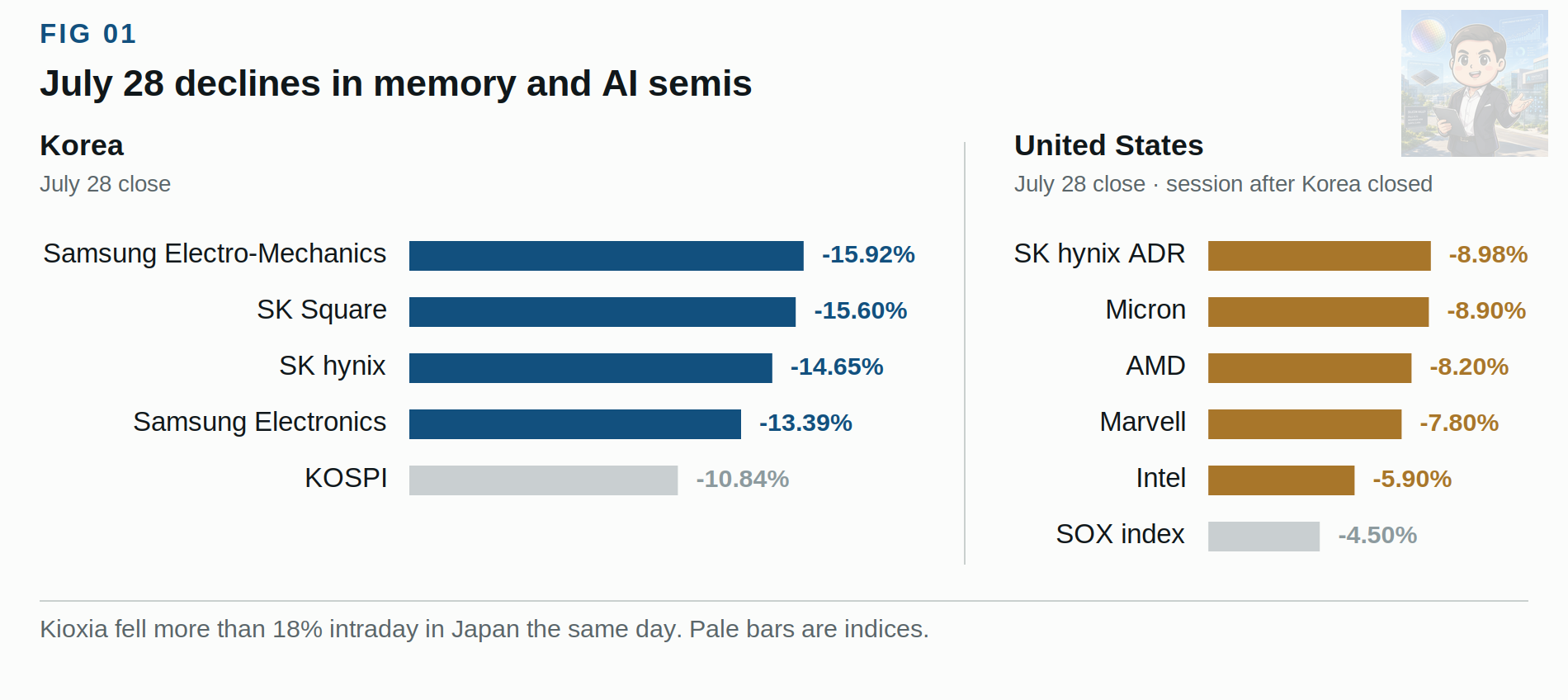
On the surface the biggest driver was news out of China. CXMT, which listed in Shanghai the previous day, jumped 471% on debut and passed Intel in market value, and a report that China had begun developing immersion DUV lithography sent ASML down 5.8%, Nvidia 5.0% and Micron 2.3% in New York overnight. On top of that, the disclosure that Nvidia had backstopped $250 billion of OpenAI data center investment revived concerns about circular financing inside the AI complex.
Analysts largely converged on the same read. The move did not make sense on its face; no genuinely new negative had emerged, and weakened sentiment plus unstable flows had amplified the decline; no single headline explained it; and the drop looked excessive relative to fundamentals.
What the Market Is Worried About
So what is the worry that is actually driving this? In my view every part of it starts with memory.
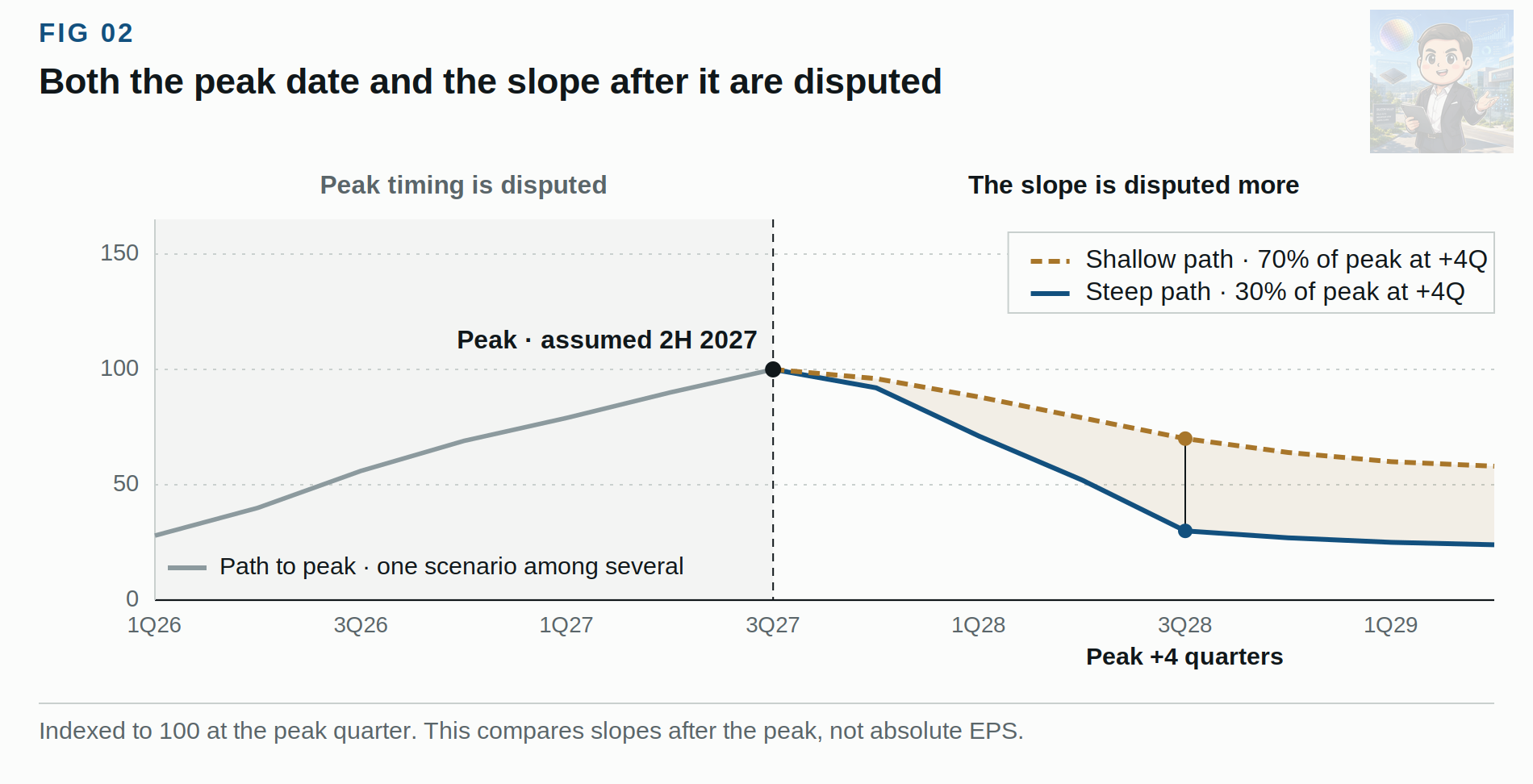
Memory is a price-cycle industry, so earnings do not compound in one direction forever. Forecasts diverge on when profits at Samsung Electronics, SK hynix and Micron turn over.
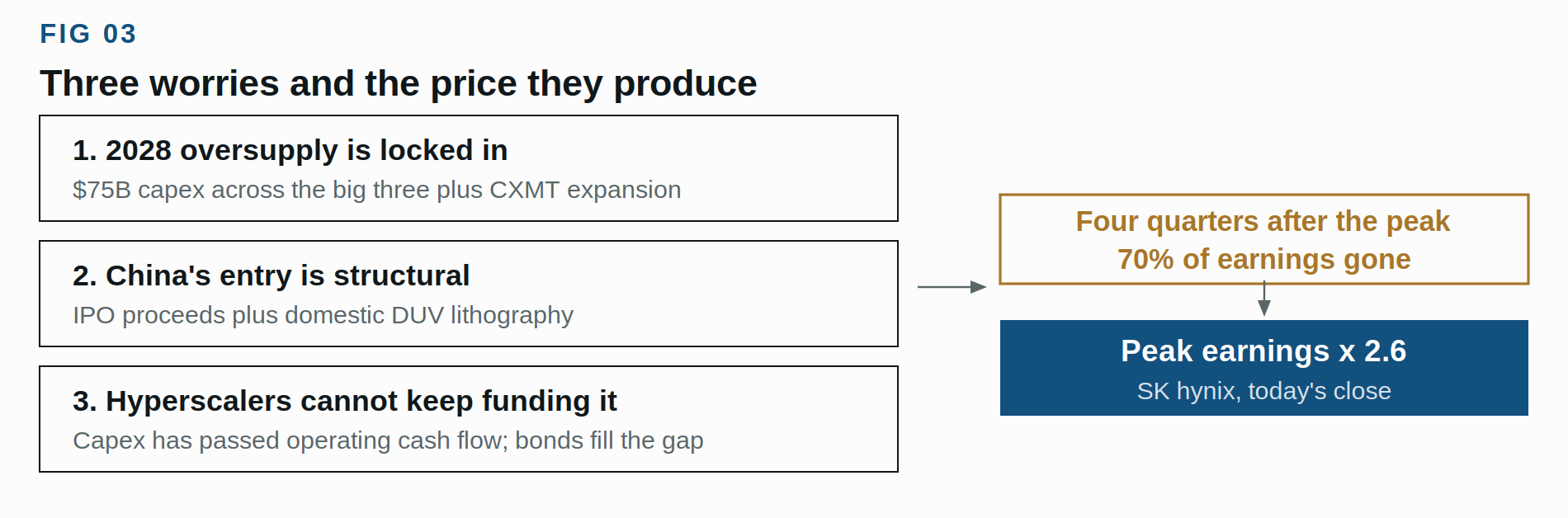
Working backward from today’s price shows what the market is picturing. SK hynix peak quarterly EPS of 150,000 won annualizes to 600,000 won, and today’s close of 1,555,000 won is 2.6 times that. No company whose peak earnings hold gets a 2.6 multiple. If earnings instead fall to roughly 30% of peak, or 180,000 won, the multiple becomes 8.6 and lands in ordinary territory. Today’s price, in other words, is a selloff that assumes 70% of peak earnings disappears, and the market appears to expect that disappearance to be complete within four quarters.
For that to hold, supply has to arrive all at once in 2028 while AI demand stops at the same time. It requires three things to be true together: that 2028 oversupply is already locked in, that China's entry is structural, and that hyperscalers can no longer keep funding the buildout. Will that actually happen? From here I take each scenario in turn.
Record Capex, Fewer Bits
The market’s worry is that $75 billion of combined capex at the big three lands as bits in 2028. I think that is somewhat overdone. The step that converts capex into bits does not appear to account properly for HBM.
HBM structurally lowers the number of bits that come off a given wafer. What matters is that the multiple is not fixed; it grows with each generation. Shipping 1GB of HBM3E consumed roughly the wafer area of 3GB of commodity DRAM, and 16-high HBM4 pushed that to four times.